One of the major headlines coming off the reveal of Halo: Campaign Evolved was that, for the first time ever, Master Chief and the Halo franchise are coming to PlayStation. While that was enough to garner attention for the 25th-anniversary project, when I was at Halo Studios in May for our current issue’s cover story, we got on the topic of what PlayStation fans can expect when Halo: Campaign Evolved finally arrives on Sony’s platform in July.
“Halo has traditionally been a one-console franchise all the way back to its origins,” game director Greg Hermann told us in October. “We’ve seen in the past few years with Master Chief Collection or Infinite that we’ve expanded onto PC, and then really started to understand what it meant for us to do cross-platform development, and then what crossplay meant in some of these circumstances. Moving onto PlayStation was just a natural evolution of that. We were building on a lot of foundation work that Unreal Engine provides for us, but it really wasn’t too foreign to us to add another platform and make sure we budgeted across development timelines, ensuring that everybody gets a premium experience for their device.”
With that mentality, loyal PlayStation players will finally have the chance to experience the foundational shooter through this remake, complete with crossplay and cross-progression, in case they want to play the remake’s four-player co-op with some of their friends over on the Xbox side of the fence. However, it may feel like sacrilege to suggest that a PlayStation console might be the best place to play a Halo game, but after going over the PS5 Pro enhancements, it sure sounds like PS5 Pro will be the best place to play Halo: Campaign Evolved. The PS5 Pro edition of Halo: Campaign Evolved uses PlayStation Spectral Super Resolution, SSD optimization, faster loading, 3D audio, and DualSense-exclusive features, leading me to believe that even Microsoft’s Xbox Series X will have a hard time keeping up with the experience on PS5 Pro.
When I ask Halo Studios, they decline to directly say that PlayStation 5 Pro is the best place to play Halo: Campaign Evolved, but it seems relatively clear. However, with the most recent Xbox Showcase, the platform holder is poised to roll back its recent stance on bringing some of its franchises to other platforms, beginning with Gears of War: E-Day and Clockwork Revolution. As Xbox’s flagship franchise since its inception, it would be unsurprising to see future Halo games join those titles, but that remains to be seen. For now, Halo: Campaign Evolved is set to arrive on PlayStation 5, Xbox Series X/S, and PC on July 28.
To learn more about Halo: Campaign Evolved, subscribers can check out our cover story. To learn more about Microsoft’s current strategy, read our conversation with Xbox chief creative officer and former head of Xbox Game Studios Matt Booty here.
Today we revealed our latest Game Informer cover story, an exclusive deep-dive look ahead at the upcoming release of Halo: Campaign Evolved, alongside a look back at the profound impact of Halo: Combat Evolved, featuring interviews with the original creators who helped shape that milestone project 25 years ago.
As a thank you to fans of the magazine and Halo more broadly, we’re making our new cover art available for download (in multiple sizes and formats) for free, without logo, wording, or other embellishment.
We also had the chance to speak with lead concept artist Sam Wood, who created this beautiful piece to grace our cover, and learn about his inspirations, process, and some secret insights into the colors and positioning of everything you see on the cover.
We hope you enjoy!
Download the Cover Art
Use the detected match for your current screen or select a display preset below, available for mobile, desktop, and ultra-wide setups.
DETECTING YOUR DEVICE…
Need a different resolution?
GI: What were your goals/vision behind this art piece?
Wood: To properly introduce Halo: Campaign Evolved, we wanted to create a cover image as bold and colorful as the game itself. We knew we wanted a piece that celebrated the 25-year history of the iconic franchise, while also introduce the franchise to new audiences. So the piece needed something of the legendary about it as well.
Was there a specific style you were shooting for? Our Studio Art Director, Chris Matthews, proposed a classic sci-fi movie poster composition; a “hero pyramid” with the Master Chief dominating the center and a large ensemble of heroes and enemies around him.
With that brief, I couldn’t avoid walking in the footsteps of the late Drew Struzan, who used masterful compositions, accurate portrait drawing, and translucent airbrushed colors to create truly iconic movie poster art. Also inspired by Struzan, I used deliberate color grouping to organize the image into warmer and cooler zones, which makes the complex composition easier to take in.
Any particular inspiration behind this approach?
Unlike a lot of concept art and illustration, this is an image that doesn’t show one specific character, scene, or moment, but is rather a collage of faces and figures, with supporting details and thematic elements surrounding them. Thus, it feels timeless and a bit nostalgic. The characters hang in an undefined space, lending them a larger-than-life presence. The fact that the visual relationships are symbolic rather than literal invites us to ponder how we feel about them and how they relate to one another across the entire Halo saga.
What is your general process start to finish for a piece of art like this?
Following my usual approach, I started out with several rounds of black-and-white thumbnails and sketches to get the composition locked in. These were accompanied by color and value studies. The next step was to go into Unreal Engine to light and pose each character individually. While not a technique I always use, digital renders are invaluable for achieving accurate character likenesses on a tight timeline. I composited these renders into a single Photoshop document and then got to work painting, lighting, and adding visual effects to bring the final image together.
Any insights or context to share about what is depicted in the image?
This image revolves around the Master Chief, flanked by the two companions – Cortana and 343 Guilty Spark – who accompanied him through most of his adventure on the first Halo Ring. Clustered around these three are a selection of friends and foes, most of whom will be familiar to longtime players – though one or two might be new faces. Each half of the image is dominated by a color symbolizing one of the threats faced in the game: the browns, yellows, and oranges of the encroaching Flood and the alien purples, blues, and teals of the Covenant. Only Master Chief’s iconic green armor defiantly breaks free from this scheme.
Anything else you’d like to share about this image?
It was a real privilege to get to work on this piece. Sometimes I felt like the mantle of responsibility was resting heavily on my shoulders, but mostly I was just having a blast trying to figure out how to make it all work. If it conveys even just a fraction of how colorful, ambitious, fun, and legendary of how Halo: Campaign Evolved, then I’ll call it a success.
If you’d like to read our complete coverage of Halo’s 25th anniversary, learn exclusive details on Campaign Evolved, and receive this art and issue to lay out on your coffee table, visit our subscription page
To call Halo: Combat Evolved an important milestone in gaming’s history would be to vastly understate its influence. The seminal console first-person shooter revolutionized the genre, effectively changing the course of gaming history. This year, to celebrate the 25th anniversary of that all-important first adventure starring Master Chief, Halo Studios is delivering a remake of that title, Halo: Campaign Evolved. We’re thrilled to reveal the iconic imagery of Chief, Cortana, and other key figures in the first Halo adventure graces the cover of the next issue of Game Informer.
Back in May we flew out to Redmond, Washington, home of Halo Studios, to spend a full day with the team creating this impressive remake. We played through the entirety of the three new prequel bonus missions and sat down with those behind Halo: Campaign Evolved for hours to dig into the team’s philosophy with this remake. Not only that, but we also spent several hours with some of the most important figures behind the original Halo games to learn how Bungie delivered an unlikely classic amidst a season of massive change for the studio. In total, our celebration of Halo: Combat Evolved and in-depth cover feature on Halo: Campaign Evolved spans a massive 22 pages, one of the biggest cover sections in Game Informer history.
And just get a look at this gorgeous art. In an extremely rare move, this art, created by concept artist Sam Wood, will be downloadable in high resolution for the device of your choosing, without the Game Informer logo. You can access the high-resolution art and read an interview with Wood on the creation of the art here.
But despite how much space we’re dedicating to Halo in this issue, there’s still so much more packed into this issue. Within the pages of this issue, we have dedicated features looking at Rayman Legends Retold, Resonance: A Plague Tale Legacy, and Ace Combat 8: Wings of Theve. We also spoke with Warren Spector about his amazing career and the developers behind Saros. We also have a feature on comedy in video games by Emmy-nominated writer Mike Drucker, as well as a look at the history of controversial games that stirred up moral panics by former Game Informer editor and Marvel’s Midnight Suns and Civilization VI writer Ben Reeves. That’s in addition to our standard suite of previews, which includes games like Call of Duty: Modern Warfare 4, Stranger Than Heaven, Tomb Raider: Legacy of Atlantis, Marvel’s Wolverine, God of War Laufey, Control Resonant, and more!
Subscribers can read the digital edition right now! Physical versions will begin arriving in the mail in mid-to-late June, and you can expect to find the magazine in bookstores and newsstands around the same timeframe. Be sure to subscribe today to receive 10 Game Informer magazines a year (physical and digital) and get the Halo: Campaign Evolved magazine as your first issue!
Clive Barker’s Hellraiser: Revival is set to help kick off the Halloween season thanks to the reveal of its launch date. The survival horror adventure set in the popular Hellraiser universe is coming on October 8.
The single-player first-person adventure features an original story, with players controlling Aidan as he must rescue his girlfriend from the hellish Labyrinth. Naturally, the infamous Pinhead is front and center, with original actor Doug Bradley reprising the role. Gameplay sees Aidan wielding guns and supernatural abilities such as pyrokinesis, telekinesis, and Hell Chains to battle supernatural threats. Check out the game’s latest trailer below.
Clive Barker’s Hellraiser: Revival is developed by Saber Interactive and Boss Team Games. It will launch on PlayStation 5, Xbox Series X/S, and PC.
Summer Game Fest 2026 has come and gone. But while the GI crew was out in Los Angeles, we took the opportunity to invite a few of our games media pals up to our studio to chat about everything: the state of the industry, how SGF has grown and changed, and of course, all the games we’ve played (that we can talk about right now).
Join us for an extra special, extra-long episode of The Game Informer Show, live from Los Angeles, brought to you thanks to Rode and their excellent equipment which powered our entire studio setup. Thanks for the sponsorship, Rode!
Earlier today, Kotaku reported that South of Midnight developer Compulsion Games may be closing its doors following a report from last week that Xbox is preparing another round of significant layoffs. Although we still have no official confirmation of Compulsion’s status, it may not be the only studio at risk of being shuttered.
Bloomberg reports that Compulsion Games, along with other studios, including Hellblade developer Ninja Theory and Psychonauts developer Double Fine, are at risk of being shut down by Xbox. The news comes from sources close to the situation who have not been authorized to speak to the press. According to Bloomberg‘s sources, each studio is negotiating with Xbox to buy itself back and go independent, though that would result in significant job cuts. Bloomberg also reports that employees at these studios have been made aware of the situation and given permission to look for new work.
If true, this information lines up with Kotaku’s earlier reports that Compulsion’s leadership is negotiating with Microsoft over the studio’s future; the exact details of this alleged discussion are unknown. Microsoft has not officially confirmed Compulsion’s closure, and the studio has not issued an official statement on the matter. However, some studio employees, such as writer Bijan Stephen and senior writer Zaire Lanier, made social media posts today announcing they are looking for work.
Last week, it was reported that Xbox CEO Asha Sharma and chief content officer Matt Booty were planning layoffs. A message penned by the pair was sent to staff detailing an “Xbox Reset” to address ongoing issues at the company. Part of this message stated that Xbox “overextended” itself by acquiring so many game studios over the last several years, while acknowledging other challenges such as declining revenue, hardware component shortages, and systems described as “overly complex” and not ready for the years ahead.
“For some of you, these realities will be surprising and even frustrating to discover. We won’t succeed by hiding hard truths, nor will we succeed by doing the same thing and expecting different results. Like the ‘everyday wins’ mentality from the first 100 days, we will sprint to make progress against hardware, content, experience, and services together,” reads a section of Sharma and Booty’s message.
Microsoft announced its acquisition of Compulsion Games and Ninja Theory during E3 2018; at the 2019 show, it announced it had purchased Double Fine. Compulsion’s most recent release was South of Midnight, which launched in 2025 to positive reviews. As noted by Kotaku, the studio had announced it was hiring only two months ago for work on a new IP.
At the Xbox Games Showcase during Summer Game Fest last week, Ninja Theory announced a new Hellblade game simply titled Senua and billed it as a pure action experience compared to previous entries. Senua is scheduled to launch in 2027. Double Fine launched its multiplayer party game Kiln earlier this year, and has shipped 2024’s Keeper and 2021’s Psychonauts 2 under the Xbox umbrella.
Game Informer has contacted Compulsion Games for comment and will update this story should they respond. Keep in mind that this is a developing story and nothing has been confirmed. We’ll be keeping an eye on the situation and will update the story as more details become available.
Electronic Arts has announced EA Advertising, a new platform “transforming how brands connect with audiences through digital and real-world experiences across its global portfolio of games.” The platform will allow brands and partners to create “bespoke integrations” across EA’s portfolio of games, such as its roster of sports titles.
EA Advertising will enable brands to be integrated directly into gameplay experiences “through dynamic, real-time placements, from stadium signage to custom in-game content, designed to enhance, not disrupt, the player experience,” according to a press release. “In these interactive gameplay environments, brands become part of the game itself, reflecting how players engage with advertising in real-world contexts.”
EA states that brands can be activated across live environments and that ad placement will be customized to “meet campaign objectives, and update campaigns with ongoing optimization informed by aggregated engagement insights.” Some of the brand integrations EA uses as examples include digital ad boards, scoreboards, and brand broadcast overlays for its sports titles. Advertisers can also collaborate with EA “in a privacy-safe way” to improve ad targeting and take advantage of the EA Sports Partner Program, a premium ecosystem for select partners to develop “in-game integrations, live service activations, creator tools, social play experiences, and community-driven programs.”
EA Sports College Football 27
“Players come to EA’s games and live experiences every day to play, watch, create and connect,” said David Tinson, EA’s chief experiences officer in the press release. “That gives brands a meaningful opportunity to show up in ways that add value and respect the player experience, while maintaining authenticity in the worlds our teams are building. With EA Advertising, we’re helping brands become part of those moments in ways that are relevant and built for players.”
Visa, Lowe’s, Red Bull, Xfinity, Peacock, and Mountain Dew have already partnered with EA Advertising after already appearing in titles such as Madden, College Football, and FC.
Few games are more deserving of a remake than the original Gothic. Over 25 years ago, this RPG from a small German team redefined the genre’s possibilities with its scope, scale, and unparalleled freedom. Although most people here in the West weren’t even aware of it, Gothic influenced a generation of European developers; its DNA can be seen in everything from The Witcher to Stalker and beyond. Now Alkimia Interactive has taken on the task of rebuilding Gothic for a new generation, and perhaps more importantly, revitalizing it for old fans. The result is a remake that does both, walking a fine line between dedication and innovation while making only a few missteps along the way.
The vast, dense penal colony of Khorinis has never looked better, and you’re completely free to explore it as soon as your nameless convict gets thrown into it. From the frosted peaks to the winding rivers, Alkimia has beautifully rebuilt the colony in Unreal 5, complete with both new content and restored cut content. From the moment I set out until I saw the credits roll, I lost count of the number of times I stopped to stare while climbing a mountain face, standing atop a castle keep, or wading through a swamp, all beneath the huge magical barrier keeping everyone and everything in.
What really sets Gothic’s world apart, though, is its sense of discovery and self-sufficiency. You can go almost anywhere at any level; there are no forced tutorials, map markers, or hard barriers (other than the magical one overhead). The forests, mines, and ruins of the colony are packed with deadly creatures and empowering treasures in equal measure, just waiting for you to exploit them or die trying. Nothing comes free, either; you have to cut deals with your fellow prisoners if you want something even as simple as a map (or you can play a dreadful new lockpicking minigame). Fans will be thankful that Alkimia has firmly committed to the original’s unsparing design philosophy, and lovers of games like Dragon’s Dogma and Elden Ring will feel right at home.
Combat and movement have also been fully revamped for this remake, and both are much more functional… when the poor technical performance isn’t dragging them down. The rigid, clumsy swinging and shooting of the original game has been converted into a much faster, more accurate combo system. Movement is greatly improved over the formerly stiff, tank-like controls. The game still punishes you for mashing buttons and leaves you wide open after a swipe or dodge, but once you’re trained up and the combo system clicks, you can weave attacks and dashes together in satisfying ways.
Even when you understand the game’s combat, however, you’ll still be fighting against framerate drops, wonky hitboxes, and the occasional teleporting enemy. Pervasive technical issues and performance problems are the worst things about this remake in its current state. Even while playing on modest settings, the framerate doesn’t stay stable for long. There are buggy animations, collision traps, and plenty of other annoyances. However, none of these things are truly game-breaking, and it simply wouldn’t be Gothic without some amount of janky charm.
Despite all the games it influenced over the years, Gothic still stands alone. This remake is both faithful and fresh, providing much-needed improvements and wider accessibility in spite of its unforgiving nature and undeniable eurojank (a term the original Gothic helped establish). Newcomers may feel the game is a relic in some ways, but anyone interested in an underplayed yet seminal classic owes it to themselves to give Gothic 1 Remake a shot.
When I ask Onimusha: Way of the Sword producer Akihito Kadowaki and director Satoru Nihei if they feel the pressure of having to follow two well-received Capcom releases this year, Resident Evil Requiem and Pragmata, they candidly confirmed they do. The pair even shares that the producers for those two games routinely wish them good luck on keeping up the momentum whenever they cross paths at work. I can’t imagine how nerve-wracking that could be, especially since Way of the Sword is the first Onimusha game in many years, adding additional pressure to get it right for starved fans. But if what I played of the game during Summer Game Fest is any indication, Kadowaki and Nihei may have little to worry about.
Onimusha: Way of the Sword stars a fictionalized version of the real-life master swordsman, Miyamoto Musashi (whose in-game likeness is modeled after the late actor Toshiro Mifune). When demons known as Genma invade Kyoto, Musashi becomes unwillingly bound to the Oni Gauntlet, a powerful heirloom that can also talk. The gauntlet, who identifies as Shizuka, combined with Musashi’s unparalleled swordsmanship, makes the pair the perfect heroes to purge Kyoto of this threat, much to the reluctant Musashi’s chagrin.
My demo unfolds midway into the adventure, with Musashi encountering a blind woman outside of a village. The chipper lady says she can tell Musashi resents the Oni gauntlet and the trouble it’s brought him and offers a solution: visit the Yasui Konpiragu Shrine in town, where all of his problems will be solved. Upon entering the village, which is enveloped in a dreamlike golden glow, I encounter unsettlingly cheery citizens who tell me how happy they are to have had their wishes granted by a mysterious god. An old man suffering from chronic knee pain sought relief, so his leg was amputated. A couple who wished to stay together forever were turned into a pair of smiling, creepy dolls. Neither Musashi nor Shizuka knows what to make of this strange place, but they know it can’t be good. Shizuka suggests contacting the soul of a heroic oni named Yorimasa, who died in battle, to help sort this place out.
Unfortunately, visiting Yorimasa’s grave yields no results, so Shizuka suggests calling upon the help of the Eight Stout Pillars. These talking statues stand high on ceremony, but only five are present; three of their brothers are missing, and we’ll need to find them to receive their collective blessing. Exploring the village to find these stone figures leads to many combat encounters, giving me a chance to see how the action has evolved since I played an earlier section of the game last August. The answer is that it’s still very good.
Hacking foes apart still feels somewhat deliberate yet flashy, but countering and parrying is Way of the Sword’s bread and butter. Enemies have health and stagger meters, and parrying attacks whittles down the former, which can open them up to attack. Parrying feels great thanks to satisfying feedback and smooth counter animations (achieved using motion capture using a real-life sword expert, according to Nihei), such as slicing off a limb or carving a foe in half. Projectile attacks can also be deflected back to their senders. My demo featured floating demonic heads that spat energy balls; deflecting those attacks lodged them right back into their mouths, causing them to explode into a mess of blue ooze.
Auto-directional blocking allows Musashi to guard against attacks from all sides, while dodging attacks at the last moment lets Musashi shift behind them in a near-supernatural fashion, opening them up to counterattacks. Successive parries or blocks build respective meters that, when full, cause Musashi’s sword to radiate a blue aura. When in this state, Musashi can cut down multiple foes in quick succession. Filling the dodge meter unleashes a different but still devastating multi-hit attack. Break Issun attacks, flashy finishing moves that act as emphatic exclamation points to encounters, have been made even more impactful over the past few months due to player feedback, Nihei shares.
Defeated enemies drop souls that I manually absorb into the Oni gauntlet by holding a shoulder button. I’m doing this a lot because I choose to rush into most encounters head-on despite having the option to stealth execute oblivious foes. I enjoy the combat that much. Plus, I want to master parrying, given how important the mechanic seems to be for success. I collect the three missing Stouts and return them home. As a reward, they use their power to condense the malice in the area into one spot, making it easy to identify the Genma responsible for granting these so-called miracles.
I return to the village, which has lost its idyllic glow and is now tinted in ashen grey. I spot a black mass of energy ahead, and upon reaching it, I’m treated to a flashback. A woman is shown praying to a shadowy Genma known as Rasho-gan, who asks her if she’s “joining” or “severing”. The woman cries about how she’s been forced to play the Shamisen every day and is scolded by her mistress when she plays badly. She doesn’t want to practice playing her instrument anymore. Rasho-gan offers a twisted solution: severing the woman’s fate using her fingers. He takes out a large pair of scissors. Unfazed, the woman offers her hands, and Rasho-gan amputates her digits in one slice (off-screen, thankfully, but the sound is gross nonetheless) as Musashi watches in shock and horror. The woman barely flinches and is quite pleased to realize she’ll never have to play her instrument again.
Rasho-gan admires his bloody prize as Musashi remarks about how messed up this situation is. Suddenly, what we thought to be a magical recording of Rasho-gan from the past suddenly turns and addresses Musashi directly. The creature attempts to sweet-talk Musashi into letting him remove the gauntlet by taking his entire arm; Musashi is nearly bewitched by Rasho-gan’s supernatural charms before Shizuka yells for him to snap out of it. Good thing, too, because Musashi catches Rasho-gan’s massive blade at the last moment, kicking off one hell of a boss fight.
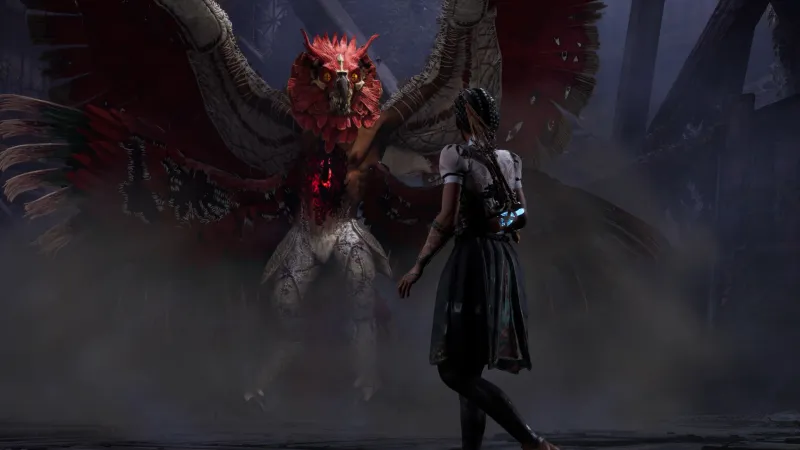
As the battle starts, Rasho-gan takes his true form: a disturbing humanoid mass of human arms and hands. A defiant Musashi tells Rasho-gan he won’t be getting anything from him. Rasho-gan wields a large sword and connects to surrounding objects using what I can only describe as spectral umbilical cords. Hacking away wildly at this boss has limited success, but I soon realize that parrying will win the day. Playing defensively and deflecting his tricky attack patterns drastically lowers his stamina meter, creating openings to retaliate. This intense sword dance reminds me of the best battles in Sekiro: Shadows Die Twice, which is probably the highest praise I can offer. I wouldn’t say Way of the Sword’s parry is just as good as Sekiro’s, but the intensity and satisfaction of deflecting attacks is definitely in the ballpark.
Other attacks can’t be blocked, such as when Rasho-gan uses his cords to pick up large objects, such as boulders, trees, or even entire buildings, to throw at Musashi. Quickly firing Musashi’s bow to sever these connections causes the objects Rasho-gan holds to crash down on him, dealing damage. A lot is happening in this fight, but I find my rhythm parrying his attacks and interrupting his ranged moves, until I finally bring Rasho-gan to his knees. Unfortunately, I don’t get to finish him, as Rasho-gan makes a run for it. He doesn’t get far, however, thanks to a fatal intervention from a character I won’t spoil.
“That particular boss, Rasho-gan, rather than being kind of born from a particular kind of monster or mythological creature, is more kind of tied to the location itself,” explains Nihei through a translator when I ask about the inspirations for Rasho-gan. “So the place that you fight him in, Yasui Konpiragu temple in Kyoto, it’s a real temple. And that place has long had legends associated with kind of bonding and separating fates, and there’s a lot of imagery tied to that with the threads and cords. So kind of thinking about that location and what kind of twist [we] could put on it is kind of where that boss was essentially born from.’
I loved this battle, and it ended my time with Onimusha: Way of the Sword on a high note. Every Sekiro fan has probably been chasing that game’s highs since 2019, and while I won’t say Capcom’s action game is the second coming of From Software’s ninja classic, it’s one of the closest to reach that style while still feeling distinctly Onimusha. Tack on how much of an entertaining pair Musashi and Shizuka seem to be, and I can’t wait to face everything this corrupted Kyoto throws at me on September 25.
Naoki Hamaguchi is ready for something new. Following more than a decade of work as the director of the acclaimed Final Fantasy VII Remake trilogy, Hamaguchi has more than earned his place among the acclaimed group of luminaries at Square Enix. However, with the announcement that Final Fantasy VII Revelation, the final part of the trilogy, is releasing in the first half of next year, it’s time for Hamaguchi to grapple with a big question: What’s next?
Though Hamaguchi is often looked at as part of the “new generation” of Square Enix developers, the Remake trilogy director has been around since the PS2 days, with his first official credits at the publisher appearing on Final Fantasy XII. However, relatively speaking, when compared to his fellow supervisors on the Remake trilogy, Yoshinori Kitase and Tetsuya Nomura, who joined Square in 1990 and 1991, respectively, Hamaguchi is the youngest of that trio.
“There’s a deep respect among each other between the three of us, and I really feel that during our day-to-day jobs,” Hamaguchi tells Game Informer. “It’s really nice to feel that, because both Nomura and Kitase, respectively, are the producer and the creative director of the overall FFVII franchise, not just the Remake series, so they have a much bigger role than I do, where I’m just in charge of the Remake series in general. Nomura and Kitase both put their full trust in me in terms of putting the Remake series in my hands, and that’s really nice to see. But at the same time, unlike Nomura and Kitase, I wasn’t involved in the development of the original Final Fantasy VII, so whenever I feel like I’m suck in the creative process in terms of determining this particular moment or scene and what kind of weight it holds, what kind of meaning it has for the original, then it’s really nice to have the two right by my side. I can just go to them and get their input if I’m ever doubting myself or anything.”
Hamaguchi has been laser-focused on the Final Fantasy VII Remake series since its inception, leaving little time for other projects. But with Revelation right around the corner, and Hamaguchi’s work on this trilogy garnering him more positive attention than ever before, fans are excited for what he could do next.
“Right in this moment, I’m fully focused on completing FFVII Revelation and ensuring we’re delivering the FFVII Remake series in a perfect state, so that’s where I’m right now,” Hamaguchi tells me. “At the same time, I do see a lot of fans and community asking me to take on the helm for a FFVI remake [editor’s note: PR later clarified Hamaguchi was talking in hypothetical terms]. [laughs] So, I’m seeing a lot of that floating online, but, you know, a Final Fantasy VI Remake or any other remake, it could be me, or it could be someone else. Personally, I think that it might be in better hands if it went to another creator in Square Enix.”
However, Hamaguchi has been kicking around some ideas for what might be next for him. “In terms of what I personally want to do, obviously, I think my next creative work is also going to be a JRPG,” he says. “When you look at all the other titles that we have released at Square Enix, not just the FFVII Remake series, I think Square Enix, as a brand, as a company, is more than capable of delivering this grand-scale RPG that could resonate to gamers across the world. Fans might have a lot of different expectations, but for me personally, I do want to take on this new challenge with another RPG title after this, whether it be Final Fantasy or a different IP. Again, we don’t know. But personally, if it’s not Final Fantasy, that’s also exciting, because that could be a challenge for me. So, whatever it is, I hope fans look forward to it.”
During that same weekend, Bloombergended its conversation with Hamaguchi in similar fashion, to which the director clarified that he is not interested in a remake. “It’s not going to be a remake!” Hamaguchi told the outlet. “As a team, I do think there’s an opportunity to work on a smaller scale, like a AA title, or a new Final Fantasy title or even a new AAA franchise. I think all those would be good.”
For now, the next game scheduled to appear on Hamaguchi’s resumé is Final Fantasy VII Revelation, which will become the first in the series to launch across all major platforms simultaneously. You can read Hamaguchi’s thoughts on bringing Final Fantasy back to Nintendo here. If you’re a fan of Queen’s Blood, the collectible-card battler minigame from Final Fantasy VII Rebirth, you can read about some of the change being implemented in Revelation’s version of the game here.