Turok: Origins Is Not A Live-Service Game, But It Almost Feels Like One

Game Informer

Platform:
PlayStation 5, Xbox Series X/S, PC

Publisher:
Saber Interactive

Developer:
Saber Interactive

Release:
2027

Rating:
Teen

Back at E3 2018, I was invited to play a licensed game based on the old-at-the-time movie and even-older-at-the-time book, World War Z. I thought the movie was alright, I enjoyed the book, and I figured an unexpected licensed game might attract some traffic online. I took the appointment, but my expectations for the actual game were rock bottom. I was surprised, however, to play a few rounds of a game that played great and made dramatic gameplay use of the visually defining zombie masses from the film, where they would climb on top of each other to create a gruesome pile. I was impressed at the time, and when I reviewed the game the following year, I gave it a strong 8.25 and often cite it as my favorite of the Left 4 Dead-inspired games that followed Valve’s lead. It made me take notice of Saber, a developer I have been consistently impressed by over the years whose output is multitudinous and often strong, even if it has never quite released an undeniable, massive hit.

Recently, Saber CEO Matthew Karch publicly stated, “I would frankly in retrospect have been happy to replace her with AI,” in response to former Saber writer and narrative designer Stella Sacco saying that is exactly what had happened – she had been replaced by AI for the game Rideshare “Stimulator” (source: thisweekinvideogames.com). Karch’s troubling statement was part of a denial saying that is not what happened; he later privately apologized to Sacco for the comments and said, “For some like me, fighting my urges is one of the hardest things I have to deal with.” He did not, however, deny the use of generative AI in Rideshare “Stimulator”. The game currently outlines how generative AI is being used on its Steam page in a content disclosure. 

The debacle and open use of generative AI in Rideshare “Stimulator” took me back to my 2018 expectations. I similarly went into a demo for a Saber game with them low, unsure of what to expect with Turok: Origins (which, by the way, does not currently feature any kind of AI disclosure on its Steam page, and I optimistically have no reason to believe it uses the technology).

Then there is the Turok of it all. The original Nintendo 64 debut was an early staple for the console, but I don’t know that I have ever met a rabid Turok fan in my life. I am sure they exist somewhere. I played the original game’s opening level a number of times and was impressed by it being an early example of a functional first-person shooter on a controller. But once GoldenEye arrived, I forgot about it and never made any time for its sequels. Turok, as a result, is a franchise I, and I am sure many others, are aware of, but I don’t know that there is a frothing demand for a new entry or sequel.

Game Informer

All of that is set up to actually playing the game. Turok: Origins, according to the team, is not a sequel but rather a new entry point for Turok, which I learned is an achievable title and not a person. You can be a “Turok”. You are not a person named “Turok”.

The demo starts with an impressive cutscene detailing invading dinosaur-like aliens using portal technology to ravage a solar system of various planets and how you are the force established to stop them. A commander unable to fight due to injury complains that his daughter, Iscah, is not ready to lead, but his AI robot/hologram companion (the sci-fi kind, not the plagiarism machine that makes people lose their jobs kind) reminds him that he wasn’t ready to lead either until he was placed in the position. From there, he starts the process of training recruits – new members ready to prove they are Turok.

I chose from a surprisingly large collection (I didn’t count them, but there were about a dozen) of playable characters with small backstories and different weapon and class options. I was transported to the Lost Lands to prove my abilities and fight dinosaurs with two other players. This is where I finally recall the headline of this article, which you have probably forgotten about by now. Playing the game reminded me of a live-service game like Destiny, with me and two other players working our way through a linear level shooting dinosaurs and using our various super abilities, each relying on a cooldown.

Game Informer

The soundtrack stood out, with a percussive rhythm narrating our dinosaur fights. I also appreciated a neat reload animation which let steam out of my gun instead of requesting more bullets. Picking up ammo and health from the planet’s fauna creates an attractive bright trail of light signifying your pickup as you sprint past. It looks cool and also lets you know when co-op partners are grabbing what they need. You can also switch between first and third-person at any time, which is a nice touch.

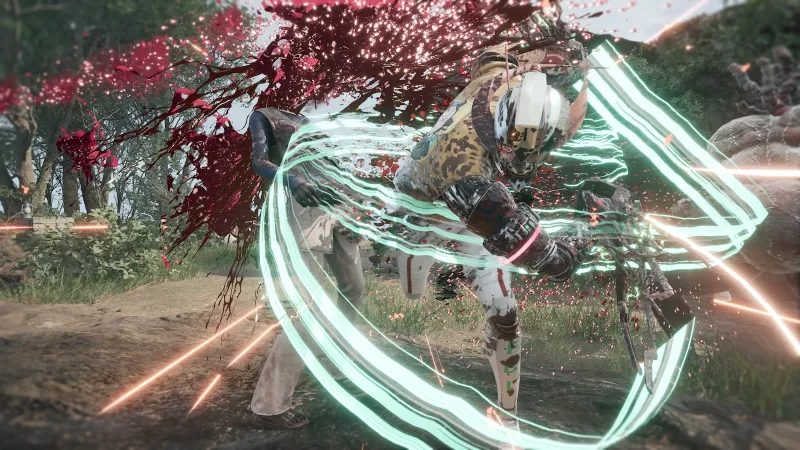
Importantly, the game also feels good. Shooting guns and arrows is responsive, and pulling off a fatality animation on a low-health dinosaur instead of just finishing it off with a few more shots is satisfying. The mechanic doesn’t seem to function exactly as it does in Doom, rewarding you with health and more for successful finale melee kills, but it seems at least inspired by it, which is a good thing.

I also played a little bit of the Switch 2 version of the game alone. Though it didn’t run at the framerate of the console/PC versions, I was impressed with how it felt and looked. The Switch 2 continues to be an impressive option for games like this, even if they are admittedly not quite as smooth as their cousin platforms.

Game Informer

On the way out of my demo, I asked if this was meant to be a live-service game; a game where you are expected to get on a treadmill to play the same levels repeatedly to unlock different materials and weapons. The team available at Gamescom plainly said no, that was not the genre they are aiming for. The entire game can be played as a single-player campaign with a narrative, and though there are incentives for replaying the levels, it is not being designed with that in mind. Considering the opening cutscene made efforts to establish named characters and specific interpersonal dynamics and outline a sci-fi story, I am inclined to believe them, even if there are elements like character classes, cooldown abilities, and encouraged three-player co-op.

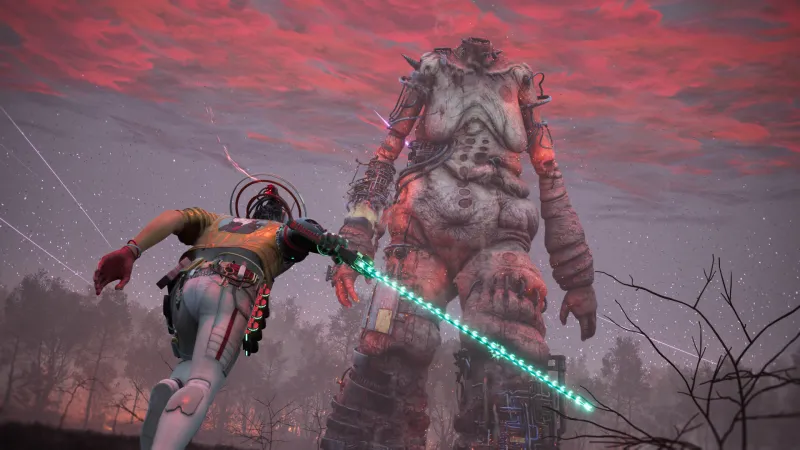
I ended the demo fighting an armored Tyrannosaurus – we had to shoot the armor off its face before we could do any real damage. The fight was big and impressive, and it took us two tries to fell the beast and enter a portal to return. At that point we had officially achieved the titles of Turok.

Overall, I was impressed with Turok: Origins. I know this may not be considered a compliment by everyone considering the strange reception the films have garnered over the years (they’re huge hits, but no one likes them or remembers them?), but I got strong Avatar vibes from the tone and action. From me, an Avatar fan, Turok: Origins should take that as a compliment. I just hope it has not quietly morphed into a live-service game upon release. I am looking for experiences, not obligations.


No Rest For The Wicked 1.0 Launch Delayed To March 2027

Game Informer

No Rest for the Wicked, the action RPG by Ori and the Blind Forest/Will of the Wisp developer Moon Studios, has been delayed. After launching in PC early access a couple of years ago, its 1.0 launch was recently confirmed for this October. This will no longer be the case.

Moon Studios has decided to push the 1.0 launch to March 2027. Creative director Thomas Mahler explains in a video update that after extensive playtesting, the team felt the game was “not quite there yet.” Specifically, it wants to further polish gameplay performance and the class system, among other general improvements.

Another closed beta test will take place in December (the final one planned before launch) to let players take the No Rest for the Wicked through its paces and provide additional feedback ahead of its launch a few months later. Moon Studios is also extending the cut-off date for receiving the Founder’s Pack containing special in-game items. Originally expired on July 1, Early Access players now have until January 1, 2027 to purchase it. PlayStation 5 players can get the Founder’s Pack when console pre-orders begin in January.

No Rest for the Wicked was first revealed at The Game Awards in 2023 and launched into PC early access in April 2024. It also appeared on the March 2024 cover of Game Informer magazine. The dark fantasy RPG centers on players fighting to rescue an island plagued by a supernatural pestilence, and its gameplay design draws inspiration from Diablo, Dark Souls, and town-building games, as players restore a settlement between slaying monsters and dungeon crawling. No Rest for the Wicked can be played alone or with up to three other players in co-op set within a shared instance of the world.

When No Rest for the Wicked launches in March, it will first hit PS5 and PC. The game is also coming to Xbox Series X/S and Switch 2 at an unconfirmed date. You can read multiple behind-the-scenes features in the game by visiting our cover story hub.

Konami Digital Showcase Will Feature Updates On Three Games Including Silent Hill: Townfall And Castlevania: Belmont’s Curse

Game Informer

Konami has announced a new Press Start digital showcase that will air Thursday morning, September 3, shortly after PlayStation’s scheduled State of Play. The presentation will provide new updates on Silent Hill: Townfall, Castlevania: Belmont’s Curse, and Rev. Noir.

The showcase begins at 8 a.m. PT/11 a.m. ET and will air on Konami’s YouTube and Twitch channels. A press release states, “In this broadcast, Konami will present information on its latest lineup—including Silent Hill: Townfall (releasing Sept. 24), Castlevania: Belmont’s Curse (releasing October 15), and the recently announced RPG Rev. Noir—interspersed with new gameplay footage and video messages from the developers.” 

It appears Konami Press Start will only feature the three advertised titles based on the verbiage. The press release specifically clarifies that there will be no announcements regarding the remake of the original Silent Hill, which is currently in production by Bloober Team.

Silent Hill: Townfall releases later this month and is a first-person adventure by Screenburn, the developer of Observation. You can learn more about the game in our extended preview from Summer Game Fest. Castlevania: Belmont’s Curse is a new side-scrolling entry by Dead Cells developer Evil Empire, and it launches next month. We played it at a recent hands-on event, and you can read our impressions here. Rev. Noir is an action RPG that was revealed during a PlayStation State of Play in February, and it’s the title we know the least about.  It’s currently slated as a PlayStation 5 exclusive and has no release window, so perhaps Konami will narrow that launch timing on Thursday.

Total War: Warhammer 40,000 Demands Destruction And Ingenuity

Game Informer

The Total War series has portrayed numerous conflicts, both historical and fantastical, but with Warhammer 40,000, the series launches into a new frontier with space, bolters and psykers in tow. It means a lot of changes for what Total War is, but its sense of scale remains intact, alongside a little bit of carnage.

I played a three-part hands-on demo of Total War: Warhammer 40,000 at Gamescom 2026, which stair-stepped me up through the layers of strategy. My personal experience with the Total War series has been frequent toe-dipping and experimenting, but never committing full-time. I love the chaos of a Warhammer 40,000 video game, though, whether that means directing my forces in Dawn of War or tearing through swarms of Tyranids in Space Marine.

So, while I’m reluctant to speak to the changes for this series, I can absolutely confirm Total War: Warhammer 40,000 can sate a thirst for explosions and declarations of loyalty to the Emperor. Four factions are currently planned for the game, and they’re the ones you likely expect: Orks, Aeldari, the billions of humans in the Imperium forces, and of course, Space Marines.

Part one of my demo put me through a small skirmish, pitting my small Space Marine detachment against a raging warband of Orks. Gradually, the tutorial walked me through the basics: units can be deployed behind a line, and then once battles commence, I can order them around, pausing or speeding up whenever I wish. 

My Space Marines may have been outnumbered, but their powerful bolters mixed with a good position – on top of a hill and in cover – saw waves of Orks dashed against the proverbial rocks. With enough time – and bombing runs I could call in on a cooldown – it didn’t take long for me to route my foes.

In the second section, I zoomed out to the larger map and commanded forces around the planet I’d found myself on, working my way towards a nearby Ork army. I made the mistake of sending a smaller force in first, rather than my larger outfit nearby, but it was fun to suddenly find myself in a position where I had to hold out for backup. 

Did I add unnecessary tension because of my own bad decision-making? Absolutely. But that seems like a fun way to enjoy this kind of game: trying to snatch victory from the encroaching jaws of defeat.


 My final section, as a Creative Assembly team member described it, was a battle on the scale of something we’d likely see in the mid-to-late stages of a campaign. I had a sizeable set of units available: some assault units and basic bolter-wielding Space Marines, a number of specialty units like psykers and heavy gunners, and even a few vehicles.

I was warned very few demo players emerged victorious from that battle, and I was not able to best expectations either. Despite carefully planning a strategy to hold a small but defensible line and then pincer from opposing flanks after the enemy closed in, it all fell to ruins fast. Partly because my units weren’t fast enough to swing around and close in while my core still held, but also because I didn’t notice my right flank was blocked off from a faster route by a parked train.

Afterwards, I confirmed with a Creative Assembly developer that I could have blown up the train and punched through to the side of my foes, but a simple “move” command sent my right-side units swinging the long way around instead. I chalk it up to user error, though it does highlight a level of destruction and ingenuity players might need to get used to having, in this far-flung future.

Getting a sense of the breadth of Total War: Warhammer 40,000’s deeper systems and scope in the time I had allotted was difficult. For other games, an hour slice might be enough of a toothpick to see if the cake’s baked well, but for something as big as a Total War game, it felt like just a taste.

I’d certainly like to see how the other factions and races fare against the Orks and Space Marines, and get deeper into the longer-term progression systems. What I’ve seen so far confirms to me that Creative Assembly isn’t holding back on its first foray into the 40,000 universe.

Orbitals Review – Space For Improvement

Game Informer

Reviewed on:
Switch 2

Platform:

Publisher:
Kepler Interactive

Developer:
Shapefarm

Release:

Rating:
Everyone 10+

The first time I saw footage of Orbitals, the anime-themed co-op game from Shapefarm, it was love at first sight. But the more I got to know it, the more I realized good relationships are built on more than appearances. Orbitals is a stunningly beautiful sci-fi adventure with decent gameplay and a disappointing story. Despite my criticisms, Orbitals is kind of like a misbehaving puppy; any gripe I have is immediately softened by its charming appearance, and I left the experience more positive than negative.

Game Informer

By far, Orbitals’ greatest feature is its presentation. Cutscenes are animated in a gorgeous retro anime style, gameplay has a similarly pleasing 3D-rendered aesthetic, and the soundtrack (especially the title theme) is an electrifying throwback. Whimsy is off the charts, with fun banter, animal-like aliens to interact with in each level, and inspired cassette futurism environmental designs.

Players control Maki and Omura, two young adults living in an isolated space station. Their home is in danger of being overrun by a deadly storm, and the only way to protect the community is to gather three reactor cassettes. The duo ventures out in their ship to explore abandoned and run-down space stations in hopes of finding the parts they need. The premise is decent enough to propel most of the game, which prioritizes gameplay over the overarching narrative.

That focus shifts in the last half hour or so, however, dumping a ton of story content on the player all at once. The resulting finale is rushed and unsatisfying, and snuck up on me after Orbitals’ mostly slow pace. Ultimately, the story concludes with moments that lacked enough setup to make the emotional payoff worthwhile. Because of this, I wish the game focused more specifically on Maki and Omura’s connections to their community rather than a MacGuffin-motivated mission. While I conceptually understood the duo loved the people back home, those relationships were talked about more than I experienced them in-game, and I never cared about most characters the way the protagonists did.

Game Informer

Maki and Omura, on the other hand, are (inter)stellar leads. While it’s never properly established, they have a fun sibling dynamic, and clearly enjoy each other’s company, speaking in sync, making puns, and singing silly songs. It’s oddly refreshing after playing similar games where the player characters are constantly butting heads – I like the person I’m playing this game with, and it’s nice to have our respective avatars feel the same way.

Gameplay is co-op only, and almost always asymmetrical, save for some minigames and occasions when Maki and Omura don’t have tools equipped. The bulk of the gameplay has each player wield a different piece of tech – usually some combination of a laser, grappling hook, and water cannon – and work together to solve puzzles. No two sections felt the same, and I was impressed by Orbitals’ sheer puzzle variety, finding new ways to use each tool.

Some felt unsatisfying and too simple; solutions were reduced to “player 1 uses a tool, then player 2 uses a tool, and vice versa until the level is complete,” with little critical thinking or coordination required. That said, the whimsical vibes help a lot, elevating middling gameplay with fun concepts. Shooting platforms at a wall for my partner to jump on wasn’t particularly exciting or novel, but when those platforms are bright blooming flower petals I’m blasting into a wall of soil, I don’t mind as much.

Game Informer

To travel between stations, you team up to pilot a home base spaceship that evolves over the course of the game with new critters and minigames. When you’re ready to take off, one player sits in the pilot’s chair and the other controls the guns. It’s an engaging way to solve puzzles, with one of us moving obstacles and flipping switches and the other maneuvering, but I was regularly frustrated by the space combat. Dodging fast homing missiles was a consistently uncomfortable affair, and one late-game sequence was downright overwhelming. 

Orbitals doesn’t quite crash and burn, but its execution leaves a bit to be desired. That said, even after a lukewarm ending, returning to the game to hear the title theme and see the smiling protagonists once more makes me undeniably sentimental. I wish I connected more to Orbitals’ story and systems, but I can’t deny its playful, cozy vibes.

Score:
7

About Game Informer’s review system

Orbitals Review – Space For Improvement

Game Informer

Reviewed on:
Switch 2

Platform:

Publisher:
Kepler Interactive

Developer:
Shapefarm

Release:

Rating:
Everyone 10+

The first time I saw footage of Orbitals, the anime-themed co-op game from Shapefarm, it was love at first sight. But the more I got to know it, the more I realized good relationships are built on more than appearances. Orbitals is a stunningly beautiful sci-fi adventure with decent gameplay and a disappointing story. Despite my criticisms, Orbitals is kind of like a misbehaving puppy; any gripe I have is immediately softened by its charming appearance, and I left the experience more positive than negative.

Game Informer

By far, Orbitals’ greatest feature is its presentation. Cutscenes are animated in a gorgeous retro anime style, gameplay has a similarly pleasing 3D-rendered aesthetic, and the soundtrack (especially the title theme) is an electrifying throwback. Whimsy is off the charts, with fun banter, animal-like aliens to interact with in each level, and inspired cassette futurism environmental designs.

Players control Maki and Omura, two young adults living in an isolated space station. Their home is in danger of being overrun by a deadly storm, and the only way to protect the community is to gather three reactor cassettes. The duo ventures out in their ship to explore abandoned and run-down space stations in hopes of finding the parts they need. The premise is decent enough to propel most of the game, which prioritizes gameplay over the overarching narrative.

That focus shifts in the last half hour or so, however, dumping a ton of story content on the player all at once. The resulting finale is rushed and unsatisfying, and snuck up on me after Orbitals’ mostly slow pace. Ultimately, the story concludes with moments that lacked enough setup to make the emotional payoff worthwhile. Because of this, I wish the game focused more specifically on Maki and Omura’s connections to their community rather than a MacGuffin-motivated mission. While I conceptually understood the duo loved the people back home, those relationships were talked about more than I experienced them in-game, and I never cared about most characters the way the protagonists did.

Game Informer

Maki and Omura, on the other hand, are (inter)stellar leads. While it’s never properly established, they have a fun sibling dynamic, and clearly enjoy each other’s company, speaking in sync, making puns, and singing silly songs. It’s oddly refreshing after playing similar games where the player characters are constantly butting heads – I like the person I’m playing this game with, and it’s nice to have our respective avatars feel the same way.

Gameplay is co-op only, and almost always asymmetrical, save for some minigames and occasions when Maki and Omura don’t have tools equipped. The bulk of the gameplay has each player wield a different piece of tech – usually some combination of a laser, grappling hook, and water cannon – and work together to solve puzzles. No two sections felt the same, and I was impressed by Orbitals’ sheer puzzle variety, finding new ways to use each tool.

Some felt unsatisfying and too simple; solutions were reduced to “player 1 uses a tool, then player 2 uses a tool, and vice versa until the level is complete,” with little critical thinking or coordination required. That said, the whimsical vibes help a lot, elevating middling gameplay with fun concepts. Shooting platforms at a wall for my partner to jump on wasn’t particularly exciting or novel, but when those platforms are bright blooming flower petals I’m blasting into a wall of soil, I don’t mind as much.

Game Informer

To travel between stations, you team up to pilot a home base spaceship that evolves over the course of the game with new critters and minigames. When you’re ready to take off, one player sits in the pilot’s chair and the other controls the guns. It’s an engaging way to solve puzzles, with one of us moving obstacles and flipping switches and the other maneuvering, but I was regularly frustrated by the space combat. Dodging fast homing missiles was a consistently uncomfortable affair, and one late-game sequence was downright overwhelming. 

Orbitals doesn’t quite crash and burn, but its execution leaves a bit to be desired. That said, even after a lukewarm ending, returning to the game to hear the title theme and see the smiling protagonists once more makes me undeniably sentimental. I wish I connected more to Orbitals’ story and systems, but I can’t deny its playful, cozy vibes.

Score:
7

About Game Informer’s review system