“Git gud,” the most common (and most empty) piece of advice floating around online, is a phrase thrown around derisively at weaker players. How do you actually get good enough to break through to the pantheon of top players?
While speaking from the perspective of a Super Smash Bros. for Wii U player, ZeRo disassembles the phrase and attempts to actually answer the question. Beyond effective practicing, studying, and attending events, he mentions how important it is to commit time to getting better. Tournaments particularly help one measure up to the competition level that lies beyond locals.
Other than that, ZeRo goes over what aspects to study and grind: knowing frame data, the right punishes, and the most effective combos all contribute to getting better.
The development of Rivals of Aether continues with the 0.15.0 patch for PC, which hits Steam today. The Beefy Aether Doods have provided a handy video guide that showcases the incoming changes.
Many of the game’s baseline mechanics have been significantly altered, contributing to a faster, more responsive overall feel. The animation of parrying a projectile can now be smoothly canceled into a follow-up attack; air attacks now have no landing recovery, which means it’s easy to continue pressure. However, there are exceptions to this–and the Beefy Aether Doods point them out. There’s also no more whiff lag, except on dash attacks.
Other major changes include a new CPU setting for parrying, an overall increase of run speed, and the ability to create custom character colors. The video finishes up with the character-specific updates.
The development of Rivals of Aether continues with the 0.15.0 patch for PC, which hits Steam today. The Beefy Aether Doods have provided a handy video guide that showcases the incoming changes.
Many of the game’s baseline mechanics have been significantly altered, contributing to a faster, more responsive overall feel. The animation of parrying a projectile can now be smoothly canceled into a follow-up attack; air attacks now have no landing recovery, which means it’s easy to continue pressure. However, there are exceptions to this–and the Beefy Aether Doods point them out. There’s also no more whiff lag, except on dash attacks.
Other major changes include a new CPU setting for parrying, an overall increase of run speed, and the ability to create custom character colors. The video finishes up with the character-specific updates.
What are some good ways to make sure time spent in training mode is efficient? In this video, ZeRo recommends a few methods to improve in Super Smash Bros. for Wii U–in general, he says it’s good to spend at least 30 minutes to an hour in training mode daily.
He emphasizes studying movement as a way to get better at the game: “Once you make sure your movement is perfect, your eye and your brain are as coordinated as possible, you’ll notice that you’ll only be focusing on the opponent, and that’s what you should be doing,” he says, in the video below.
Check out the full clip to learn more about how to utilize the CPU effectively for training, as well as how to approach tournament play.
For training methods in other fighting games, you can also refer to this editorial by LordKnight.
Under Night In-Birth Exe:Late recently appeared on Steam, giving a fresh set of players an opportunity to try out the game. Reignited interest can also coincide with trying out new characters.
Crimefighter recently put together two video character guides. They’re intended for players who are at least a little bit familiar with UNIEL terminology and notation.
“If you are new to UNIEL, Byakuya is an easy character to pick up, he’s got good damage, decent mix-up options, good neutral, and fun movement,” Crimefighter writes in the video description. “His execution is relatively low, not the easiest in the game, but pretty darn easy.”
The video explains what normal moves work at certain ranges and the properties of his special moves.
His second guide covers Chaos, a character who fights alongside a summonable lizard.
For a more basic introduction, Crimefighter wrote up a UNIEL Steam guide that covers fundamental mechanics of the game.
Arc System Works has updated the Japanese BlazBlue: Central Fiction website with some details about the gameplay modes for the upcoming console version. BlazBlue’s trifecta of practice modes, Tutorial, Training, and Challenge, will make a return; the modes will take a page from Guilty Gear Xrd -REVELATOR- and show input on an arcade stick display.
Abyss Mode has been rebranded as “Grim of Abyss.” As before, it will be a type of survival mode where your character acquires and equips gameplay-impacting skills. The Collection and Gallery Modes will allow purchasing of in-game items such as character colors, artwork, posters, and more.
The Story Mode will present the tale in an adventure game/visual novel style, with over 30 hours of estimated gameplay. The website mentions two characters “from another world” making an appearance: Naoto Kurogane and Es, the “heroine from another Tale of the Azure.”
The Wheel of Fate begins turning in Japan once more on October 6, 2016, while the American and European releases are following this Winter.
It’s been two weeks since the Grove Maiden’s introduction to the current generation of Guilty Gear. Dizzy returned with the majority of her tools intact from prior games: her ice spike, fish, sickle, and bubble all made it in. Alongside those there are the fire versions, and of course the ability to YRC anything–which, when combined with her double airdash mixups, can throw the opponent into quite a loop.
Here’s a roundup of some example combos and setups, as well as one idea on how to escape the corner.
This advanced combo shows strong okizeme that will leave the opponent blocking for a while, thanks to the chargeable fire spike. It can still be Blitz Shielded, however.
This should provide a few ideas on how to keep up pressure on a blocking opponent.
If Dizzy’s pressure isn’t tight enough, the fish can be hit after an instant block or the setup can be escaped by jumping.
There are also many more examples of combos in a Dizzy compilation document spearheaded by Faultydefense and Kizzercrate.
Looking for specific system data on Dizzy? This Japanese PDF file gives a few numbers on every character in the game. Dizzy is the last line, and it lists the values on her defense modifier, guts rating, stun resistance, wake-up times, backdash time and invulnerability, as well as jump start-up.
Are you taking Dizzy for a spin in Guilty Gear Xrd -REVELATOR-? Let us know in the comments.
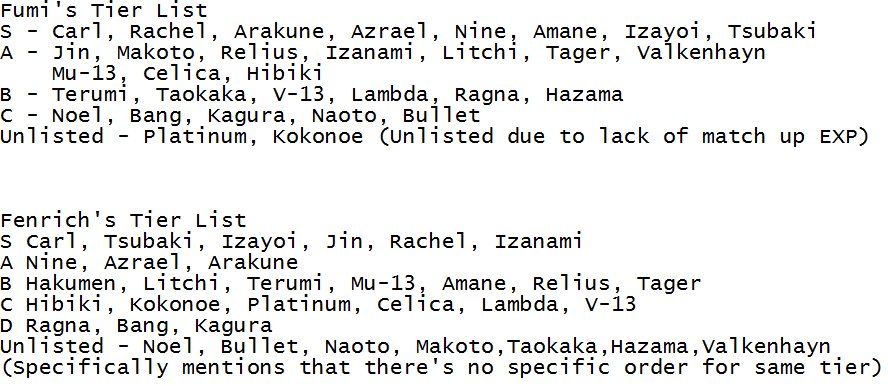
Famitsu posted an interview with top Japanese BlazBlue Central Fiction players, Fumi and Fenrich.
Fenrich, who plays Jin, is currently the number-one-ranked player in the arcades. The interview (translated by HiagoXYZ) talks about how Fenrich got started in BlazBlue and what his thoughts are on one of the new mechanics, Active Flow. Fenrich also talks about playing against his brother’s Ragna, the aspects of his gameplay that he’s working on, how to improve in BBCF, and his thoughts on which characters are strong.
The last section is a reference to this screencap of a BBCF tier list, which contains Fumi and Fenrich’s opinion on the cast.
Dust is slowly setting after the post-Evo 2016 Guilty Gear Xrd -REVELATOR- patch, which overhauled the balance in the game mainly by nerfing the top characters, Sin Kiske, Johnny, and Elphelt Valentine. Many characters have seen slight tune-ups and a few, notably Jam, received a lot of buffs. The patch also introduced Dizzy.
Niconico streamed an Arc System Works Post-Evo Festival, which showcased top Japanese talent playing with the balance patch applied (which is hitting Japanese arcades August 4th).
The video shows Machabo, Omito, Rion, and Nakamura experiencing the patch changes. Notably, Machabo starts considering playing Ky Kiske again.
American player Oso created a humorous “visual” patch notes video, which doesn’t showcase every single change that’s taken place, but provides useful examples of new things.
English voice-acting was a first for Guilty Gear Xrd -SIGN-, which had an extensive, fully-dubbed story mode. Fans speculated about the inclusion of English voice acting up to shortly before the release of the follow-up -REVELATOR-, which only featured Japanese voices.
What’s it like to be a voice actor for a fighting game like Guilty Gear? Is it worth it to try to imitate the Japanese actors as closely as possible? How do you get into character?
Shoryuken sits down with voice actor Lucien Dodge who played Sin Kiske in -SIGN-. Some of his other video game roles include the main character from Dust: An Elysan Tail, Mega Gnar in League of Legends, and characters in Danganronpa: Trigger Happy Havoc: Spike and Bravely Default. Among his anime voice appearances figure Bleach, Fate/Zero, and Kill la Kill.
Luke “Woocash”: Reaching back to Guilty Gear Xrd -SIGN-, how did you find out about the audition, and what did you think of Sin? How did that go?
Lucien Dodge: As I recall, the studio who was involved with recording the English voices contacted me about auditioning. Sin was one of the characters that they included a script for. Looking at the script for the character and reading about him, he seems like a very multi-faceted character. On the surface, he’s very happy-go-lucky and boisterous and fun, but there were moments in the storyline where he gets a little bit more serious, and he’s talking about his mom, and there was some sentimentality there. A fragile state seemed to be reflected there. I really enjoy if characters show off a wide spectrum of emotions and they’re not just one-note. Sin certainly seemed to fit that mold. Recording him was a lot of fun — he’s a little bit of a goofball, he’s very young at heart, I think he’s actually very young physically [laughs – Sin is actually 10 years old]. You have those two elements working together, where mentally, he’s very young and full of energy and wonder, but he’s really strong.
Luke: Did you have an opportunity to try out Sin gameplay, or did anyone showcase him to you?
Dodge: I did look up YouTube videos of people playing as him so I got an initial taste. I did buy the game eventually [Xrd -SIGN-] and played it long enough. I got the 100,000 World Dollars to buy him in the game, so I played it long enough to earn them, by myself! I insisted on getting him in the game and earning him that way, not via DLC. And I played him, and thought, he’s a lot of fun, he’s really cool! I like spamming his move which is a flurry of his flag pole attacks [”I’m Sure I’ll Hit Something,” follow-up to Sin’s signature Beak Driver]. He’s very nimble, I like that about his gameplay. I think it’s very interesting that he’s the only character that has a hunger meter, which I think is to balance him. So then you get a nice shot of him eating a huge thing of meat right off the skewer. I remember doing those sounds, those were pretty fun and silly to do. “Yeah just do some eating stuff.” And then Sin has an opinion. He loves food. I can relate to that. A lot of us can. Maybe I lack a bit of the superhuman strength…
Luke: When you were recording lines for moves, were you able to see them?
Dodge: No, it was pretty much, “here’s the line.” Sometimes they’ll play the Japanese version because they need to get you in the timing of the original line, so it fits when they load it in. If the Japanese version was a second long, the English can’t go over that in order for it work. I think they may have had Japanese reference clips playing so I could hear the intensity and the direction the original voice actor took, so I can take my own spin on it and match the energy to it. But in general, and I can’t remember exactly if that’s how it happened, even if they didn’t have Japanese reference clips in these cases, it was pretty explanatory. It’s in a battle, it’s all very heightened and there’s a lot of energy to it. I usually give them a couple different versions, two or three, they pick the one they like, and move on to the next. The recording process is generally pretty quick for these games. You go on sheer instinct some of the time. Sometimes you’re taking a stab at it and you think it’s going to work, and if not, they’ll tell you.
Luke: Is it more challenging or fun to provide battle quotes versus regular story mode dialogue?
Dodge: I don’t know if it’s more fun, it’s different. There are different challenges to it and different things that are fun. I grew up playing fighting games, the first game console came as a result of me and my brother going to the arcade a lot to play Tekken, all day. We told our parents that it’s available on a game station, so that’s kind of what got my affection for fighting games started. It’s very nostalgic almost, there’s a certain glee when I can do those sounds I’ve heard in all those different games. And it’s fun when I get to shout out attack names with such gusto and power. Over and extended period of time, if you’re doing a lot of takes of those, it can be really hard on your voice. I would rather go full-out and be a little hoarse rather than go halfway with it. That’s partially due to having played these games.
Luke: Going back to Sin, he came out first in GG2 Overture, voiced by Yuri Lowenthal [who voiced Bedman in -SIGN-]. Have you listened to his performance?
Dodge: I did know someone else had played the character before, but I didn’t look into it or research clips. I wanted it to be my own version. I didn’t want to be persuaded or biased by what has been done before, so I went into it fresh. I played it from my sense of what the character was — maybe different from the original English voice, but I wanted to make sure it was my own.
Luke: Voice actors tend not to get the chance to interact with each other while working, was it the case with Guilty Gear?
Dodge: No, I wish we did. Schedule-wise and fiscally-speaking, it’s not doable in these kinds of cases. But that would be awesome. I love any opportunity where I get to perform ensembles with other actors, it’s always a lot of fun. It was solo recording this time, which is a lot of extra work, because you have to be imagining what might be taking place around you, what are you responding to, and in what way. It’s another case where you trust your director to make sure you’re in that pocket, that it’s going to make sense when it’s all edited together.
Luke: You were describing Sin as a very youthful, energetic person. You sound naturally very similar to him.
Dodge: Yeah, there wasn’t a huge shift. I just got peppier, a little more upbeat, my voice is innately very youthful, so I didn’t have to do a whole lot of work to get my voice in an area that I felt matched the character and his personality. The less I have to affect it and just play it from the heart, I felt like that would keep him grounded. I wanted to be believable and have the foundation of a believable person.
Luke: This is the first time the Guilty Gear fighting games have had an option for English voice-acting. You’ve certainly listened to a lot of Japanese voice—acting and anime, what are your thoughts on Japanese versus English voice-acting?
Dodge: I was a fan of anime in my mid-teens when I first discovered it, and I was a very big proponent of the subtitled, directional, Japanese-language version. I had a very hard time liking or getting into English dubs. I just thought the Japanese versions sounded cooler, they’re kind of poetic and have strength in their cadence. Now, of course, over the years, and now as I have done a fair number of English dubs, I guess what I have to say about it is — of course, there is no innately superior version over the other just because it’s an English version of a property that’s really Japanese. Doesn’t make it a worse performance. There are a lot of factors which can go either creating a very good English adaption or a poor one — scripting, direction, casting, not even getting to even performance. You could have good actors miscast and then you’re at a disadvantage. Timing-wise, scheduling, how fast they need to get it done, how much money they could spend on it — so you may have very talented people involved in the production, but you may not be able to spend more time getting it perfect and exactly the way you want.
The English version cannot be the same, it cannot be a carbon-copy of the Japanese version. There are just too many differences from a language perspective. I think the mistake that maybe fans, or productions who record the dubs make, is that it has to be an exact mimic, but there are certain intrinsic differences. We have different sensibilities for humor, drama, we have our own archetypes.
Even if you don’t like English dubs, keep an open mind or at least understand, that there are a lot of different elements. There are productions where they couldn’t give less of a crap and they want to get it done quickly. But there are those of us in certain productions who really care and work very hard.
Big thanks to Lucien Dodge for speaking to Shoryuken. You can learn more about the voice actor on his website and @LucienDodge.